
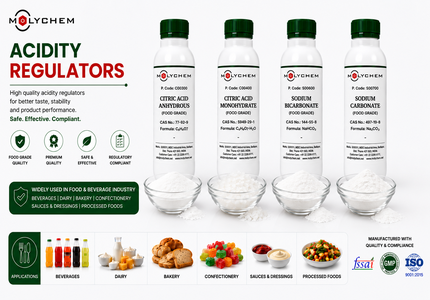
Acidity regulators control and buffer pH in food systems. Phosphates (di- and tri-basic calcium, sodium and potassium salts) are mild alkaline buffers used in processed cheese, baked goods and meat processing — their strength varies with hydration state. Carbonates (sodium bicarbonate, sodium carbonate, potassium carbonate) are stronger alkalis used for leavening and pH correction. Citric acid and sodium citrate buffer acidic beverages and dairy products.
1 to 18 of 18 item(s) displayed
| Code | Product Name | CAS | HSN Code | Packing | MSDS | Specs | COAs |
|---|---|---|---|---|---|---|---|
| C00200 | Calcium Gluconate Food Grade | 18016-24-5 | 29181610 |
25KG HDPE Drum |

|
- | - |
| C00300 | Citric Acid Anhydrous Food Grade | 77-92-9 | 29181400 |
25KG HDPE Drum |
|
- | - |
| C00400 | Citric Acid Monohydrate Food Grade | 5949-29-1 | 29181400 |
25KG HDPE Drum |
|
- | - |
| D00100 | Di Ammonium Ortho Phosphate Food Grade | 7783-28-0 | 28352990 |
25KG HDPE Drum |
|
- | - |
| D00200 | Di Calcium Ortho Phosphate Anhydrous Food Grade | 7757-93-9 | 28352500 |
25KG HDPE Drum |
|
- | - |
| D00300 | Di Sodium Ortho Phosphate Anhydrous Food Grade | 7558-79-4 | 28352200 |
25KG HDPE Drum |
|
- | - |
| D00301 | Di Sodium Ortho Phosphate Dihydrate Food Grade | 10028-24-7 | 28352200 |
25KG HDPE Drum |
|
- | - |
| D00302 | Di Sodium Ortho Phosphate Dodecahydrate Food Grade | 10039-32-4 | 28352200 |
25KG HDPE Drum |
|
- | - |
| D00400 | Di Calcium Phosphate Dihydrate Food Grade | 7789-77-7 | 28352500 |
25KG HDPE Drum |
|
- | - |
| D00500 | Dipotassium Phosphate Food Grade | 7758-11-4 | 28352400 |
25KG HDPE Drum |
|
- | - |
| P00300 | Potassium Carbonate Food Grade | 584-08-7 | 28364000 |
25KG HDPE Drum |
|
- | - |
| S00700 | Sodium Carbonate Food Grade | 497-19-8 | 28362090 |
25KG HDPE Drum |
|
- | - |
| S00800 | Sodium Citrate Food Grade | 6132-04-3 | 29181520 |
25KG HDPE Drum |
|
- | - |
| T00100 | Tri Calcium Phosphate Food Grade | 7758-87-4 | 28352690 |
25KG HDPE Drum |
|
- | - |
| T00200 | Tri Potassium Phosphate Food Grade | 7778-53-2 | 28352400 |
25KG HDPE Drum |
|
- | - |
| T00300 | Tri Sodium Phosphate Anhydrous Food Grade | 7601-54-9 | 163.94 g/mol |
25KG HDPE Drum |
|
- | - |
| T00301 | Trisodium orthophosphate dodecahydrate Food Grade | 10101-89-0 | 28352990 |
25KG HDPE Drum |
|
- | - |
| S00600 | Sodium Bicarbonate Food Grade | 144-55-8 | 28363000 |
25KG HDPE Drum |
|
- | - |
Note:
Acidity regulators control and stabilise pH in food and beverage formulations. Molychem's range of 18 food grade acidity regulators includes Citric Acid Anhydrous (CAS 77-92-9), Citric Acid Monohydrate (CAS 5949-29-1), Sodium Bicarbonate (CAS 144-55-8), Sodium Carbonate (CAS 497-19-8), Sodium Citrate (CAS 6132-04-3) and a full range of phosphate salts.
Both are the same acid in different hydration states. Monohydrate (CAS 5949-29-1) carries bound water at 210.1 g/mol, against 192.1 g/mol for Citric Acid Anhydrous (CAS 77-92-9) — so monohydrate delivers less active acid per kilogram. Anhydrous suits dry blends and low-moisture formulations; monohydrate dissolves readily where moisture is not a constraint.
Disodium Hydrogen Phosphate (CAS 7558-79-4 anhydrous) and Dipotassium Phosphate (CAS 7758-11-4) are standard buffering salts, holding pH steady rather than shifting it. Tri Calcium Phosphate (CAS 7758-87-4) additionally serves as an anticaking agent and calcium fortificant, overlapping with the minerals and nutrients range.
Sodium Bicarbonate (CAS 144-55-8, baking soda) is a mild alkali used for leavening and gentle pH adjustment. Sodium Carbonate (CAS 497-19-8, soda ash) is considerably more alkaline and raises pH far more aggressively, so the two are not interchangeable at the same dosage.
Export orders ship with batch Certificate of Analysis showing actual tested values, MSDS, specification sheet, and the HSN code required for customs. This applies across all six food-grade categories, including sweeteners and functional ingredients and the acidity regulators range.
Citric Acid lowers pH and delivers a sharp acidic taste. Sodium Citrate (CAS 6132-04-3) is its sodium salt and acts as a buffer instead — resisting pH change rather than driving it down. Beverages typically use both, often alongside a food grade preservative matched to the final pH.