
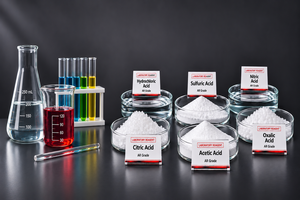
A complete buyer's guide to inorganic vs organic acids — strength, reactivity, grades (LR/AR/GR), safe dilution, storage, industries, and how to pick the right acid for your application.
Acids are one of the most frequently stocked categories in any laboratory, but "acid" isn't a single thing. Inorganic and organic acids behave differently, serve different purposes, and often aren't interchangeable in a protocol — using the wrong one doesn't just affect results, it can mean reruns, wasted reagent, and instrument downtime. This guide covers what separates the two families, which grade to buy, how to store and dilute them safely, and where each one is actually used.
Inorganic acids, also called mineral acids, are derived from minerals and typically don't contain carbon. Most are strong acids that dissociate almost completely in water, which is what makes them highly reactive and, in concentrated form, corrosive.
Organic acids contain carbon and are built around a carboxylic acid group. They're generally weaker acids that only partially dissociate in solution, which makes them easier to handle in dilute form and well-suited to applications needing a milder, more controllable acidity.
| Product | Typically Used For |
|---|---|
| Hydrochloric Acid CAS 7647-01-0 |
Sample digestion, pH adjustment, titration |
| Sulfuric Acid CAS 7664-93-9 |
Digestion, dehydrating agent, battery/industrial use |
| Nitric Acid CAS 7697-37-2 |
ICP/ICP-MS/AAS sample digestion, metal etching |
| Phosphoric Acid CAS 7664-38-2 |
Buffering, rust removal, reagent-grade applications |
| Product | Typically Used For |
|---|---|
| Acetic Acid CAS 64-19-7 |
Buffer systems, acetate buffers, general lab reagent |
| Citric Acid CAS 77-92-9 |
Chelation, metal-ion complexation, buffering |
| Oxalic Acid CAS 144-62-7 |
Metal cleaning, chelation, volumetric analysis |
| Formic Acid CAS 64-18-6 |
HPLC/LC-MS mobile phase modifier |
Concentrated inorganic acids like Sulfuric Acid and Nitric Acid are aggressive enough to digest organic matter and metals, which is exactly why they're the standard choice for sample digestion ahead of elemental analysis. That same reactivity means they need fume hood handling, acid-resistant storage, and strict SDS-compliant procedures.
Organic acids, being weaker, are generally safer to handle at working concentrations, though proper handling still applies at higher concentrations — glacial Acetic Acid, for instance, is corrosive despite being a "weak" acid in chemistry terms.
Inorganic acids show up most often in:
Organic acids tend to show up in:
The same acid can be sold in different purity grades, and picking the wrong one is one of the most common — and expensive — sourcing mistakes:
Paying for a higher grade than the application needs is a common way labs overspend on reagents — routine cleaning or bulk process use rarely needs GR grade, while trace-metal analysis can't get by on LR grade.
Diluting a concentrated acid, especially Sulfuric Acid, generates significant heat. The standard safety rule taught in every chemistry lab exists for a reason: always add acid to water, never water to acid. Adding water to concentrated acid can cause the mixture to boil and spatter instantly, since the small amount of water added first absorbs a disproportionate amount of heat. Adding acid slowly into a larger volume of water instead lets that heat dissipate safely.
Practical points for dilution:
Beyond the research bench, lab-grade acids are routine inputs across several industries:
Lab acids are supplied across standard and bulk pack sizes depending on consumption — from small lab-scale packs for routine use and R&D quantities, up to bulk packaging for higher-volume industrial or QC use. Export orders are packed and documented to export specification for international shipments. See our packing options for the sizes available, or tell us your required grade and quantity for a specific pack recommendation.
Spent acids should never be poured directly down the drain. General practice is to neutralize dilute acid waste to a safe pH range before disposal, using a suitable base under controlled conditions — but exact neutralization procedures, acceptable discharge pH, and disposal routes depend on local environmental regulations and your lab's own safety protocol. Always follow the product's SDS and your institution's waste disposal guidelines rather than a generic rule of thumb, and never mix waste acids with other waste streams without checking compatibility first.
The inorganic-vs-organic label matters less than these practical checks when sourcing:
Molychem manufactures and imports lab and industrial chemicals from its Badlapur MIDC facility, operating under ISO 9001:2015 certification with GMP certification, and supplies both domestic and export orders — including into Africa and Southeast Asia — with export-specification packing and documentation.
Is sulfuric acid stronger than hydrochloric acid?
Both are strong acids that fully dissociate in water, but sulfuric acid is diprotic (releases two protons) and more corrosive in concentrated form, making it more aggressive in digestion applications.
Can organic and inorganic acids be mixed?
Generally not recommended without checking compatibility — mixing concentrated acids, especially inorganic ones, can cause violent exothermic reactions. Always consult the SDS before combining reagents.
Which acid grade do I need for HPLC work?
HPLC and LC-MS applications typically require AR or HPLC/LC-MS grade acids (commonly Formic or Acetic Acid) to avoid baseline noise or contamination from lower-purity grades.
Is citric acid an organic or inorganic acid?
Citric acid is an organic acid — it contains carbon and is built around carboxylic acid groups, unlike mineral acids such as sulfuric or hydrochloric acid.
What's the difference between AR grade and LR grade acid?
AR (Analytical Reagent) grade has a tighter purity specification intended for quantitative analysis and titration; LR (Laboratory Reagent) grade is suitable for general lab use and routine work where trace impurities won't affect the result.
Why do you add acid to water and not water to acid?
Diluting a concentrated acid releases heat. Adding water to acid lets a small volume of water absorb a large amount of heat quickly, which can cause boiling and spattering. Adding acid slowly into a larger volume of water instead spreads that heat out safely.
Can I dispose of lab acid waste down the drain?
No — acid waste should be neutralized to a safe pH and disposed of according to your local environmental regulations and the product's SDS, not poured directly down the drain.
Get a Quotation
Pricing on lab acids moves with raw material and freight costs, so send us the products, grades and quantities you need — we'll come back with price, pack options and lead time.
Explore the Full Range
Inorganic Acids →
HCl, Sulfuric, Nitric & Phosphoric — AR/LR grades for digestion, titration & industrial use.
Organic Acids →
Acetic, Citric, Formic & more — buffers, HPLC-grade & chelation reagents.