
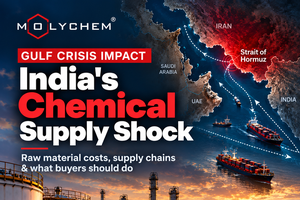
How the Strait of Hormuz disruption is driving up raw material costs and disrupting supply chains for India's chemical industry — and what procurement teams can do about it.
The Gulf isn't just an oil exporter — it's a concentrated source of the raw materials that feed basic and specialty chemical production worldwide. Industry estimates put the region's share of global ethylene glycol exports at around 50% and methanol at around 40%. Naphtha, the feedstock behind a large share of plastics and solvents, also has close to 44% of its global flows tied to the region, and the Strait handles an estimated half of the world's seaborne sulphur trade — a raw material behind sulphuric acid, fertilizers and a wide range of industrial chemicals.
When transit through the strait drops sharply, as it has repeatedly since the conflict began, these aren't commodities that can be instantly resourced elsewhere. Alternative supply either doesn't exist at the same scale or has to travel much further, at a much higher freight cost.
A quick clarification on the figures below, since they're easy to conflate: the Gulf's share of global trade in a commodity (its worldwide export or production share) is a different measurement from the share of India's imports that transit the Strait of Hormuz for that same commodity — which is different again from the share of India's total consumption that ultimately depends on the Gulf. The table mixes global-supply figures with India-specific import-transit figures; both are informative, but they answer different questions, and the precise, rapidly-moving figures below should be treated as directional rather than exact at the time you're reading this.
|
Impact Area |
Figure |
|---|---|
|
Global chemicals production (2026 forecast) Affects: Overall industry output |
Cut to ~0.6% growth, down from pre-war estimates; a prolonged closure could mean a 1.7% contraction |
|
Middle East chemical production Affects: Regional feedstock and export supply |
Forecast to contract ~3.7% in 2026 |
|
Tanker freight rates (VLCCs) Affects: Landed cost of crude, naphtha and LPG |
Reported spikes above US$400,000/day |
|
India's crude oil and LNG imports via Hormuz Affects: Refinery feedstock, fuel and downstream petrochemical costs |
Roughly half |
|
India's methanol imports tied to the Hormuz corridor Affects: Solvent supply for API and specialty chemical manufacturing |
Around 88% |
|
India's ethylene glycol imports tied to the corridor Affects: Polyester production, automotive coolants |
Close to 100% |
These figures move week to week as the conflict and diplomatic efforts evolve, so treat them as a snapshot of the situation through early-to-mid October 2026 rather than a fixed state — but the structural exposure they describe (how dependent each input is on Gulf supply) changes much more slowly than the headlines do.
The effects fall hardest on exactly the inputs the chemical industry runs on. Gujarat's chemical and petrochemical manufacturing belt has reported gas supply cuts of up to 50% following production halts at Gulf suppliers, directly stalling output at several units. Agrochemical and fertilizer-chemical manufacturers, who source an estimated 20–25% of their raw materials from Gulf countries, are facing higher costs for phosphoric acid and sulphur — both key chemical intermediates. Across the sector, chemical exporters have also reported delays and re-routing as vessels avoid the strait or face lengthy queues outside it.
For chemical manufacturers and traders specifically, the transmission is direct: higher crude and naphtha prices raise the cost of petrochemical-derived raw materials, while the sulphur and methanol exposure raises costs further down specific chemical product lines. A weaker rupee adds further pressure on anything priced in dollars — which, for imported chemical inputs, is most things.
Most of the figures above describe bulk petrochemicals, LNG and refinery feedstocks — not the laboratory reagents, indicators and specialty chemicals that make up the bulk of what a company like Molychem supplies. The exposure here isn't zero, but it works differently, and it isn't uniform across a catalogue.
Some lab and industrial chemical lines sit closer to the bulk-petrochemical chain and feel the impact more directly: products built on methanol, ethylene glycol or sulphur-derived intermediates carry some of the same feedstock-cost pressure described above. Many formulated reagents, indicators and finished specialty chemicals, by contrast, are affected less through their own raw material and more through freight costs, packaging materials, and the general cost of moving any imported good right now — pressures that apply broadly rather than being specific to a handful of commodity chemicals.
The practical implication for buyers: don't assume every product on a price list is equally exposed. A sulphur-linked reagent and a finished, India-manufactured indicator solution don't sit in the same risk category, even if both ship from the same supplier.
As a manufacturer and exporter, Molychem sits on more than one side of this disruption — and we won't pretend we're untouched by it either. A meaningful share of our laboratory and industrial chemical range is manufactured in-house at our Badlapur facility, which cushions some of the raw-material volatility the wider industry is feeling right now. That said, for the inputs we do source internationally, we are affected too — rising landed costs and freight rates are a real factor in our own planning, and we track global shipment and buyer-seller trade data closely to stay ahead of it. On the export side, with a growing order book into West and East Africa, elevated freight rates and longer transit times are a real cost to manage — but that growing international footprint also means our business isn't dependent on any single trade corridor.
If you're a distributor or buyer working with us through this period, the most useful thing we can offer isn't a prediction — it's a current, confirmed quotation and lead time on the specific products you need. Reach out to us directly on WhatsApp rather than planning around broad market forecasts; conditions on individual products can differ significantly from the headline numbers.
Sources: Atradius · Credito y Caucion · Indian Chemical News · Straits.live · Multibagg · PolymerUpdate