
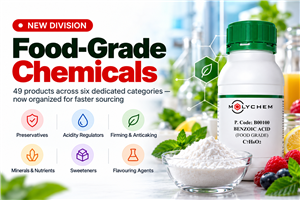
Molychem’s Food Chemicals division now covers 49 products across six dedicated categories — here’s what each category does and how to choose the right grade.
Molychem has supplied food-grade chemicals for years, but until now these sat as scattered listings with no structure around them. That's changed — our Food Chemicals division now organizes the range into six dedicated categories.
For buyers, this matters more than it sounds. Food manufacturers need consistent purity, verifiable CAS numbers and batch-level documentation — not a generic listing buried in an industrial chemicals catalogue.
Stop microbial growth, extend shelf life
Control and stabilize pH
Maintain texture, prevent clumping
Iron, zinc and sodium fortification
Sweetness, bulking, moisture control
Natural umami enhancement
Preservatives interfere with the growth of bacteria, yeast and mould. Most food-grade preservatives are either weak acids that disrupt microbial metabolism in an acidic environment, or reducing agents that limit oxidation. Our range covers 16 products across both groups, along with chelating, acidulant and gelling agents used alongside them.
| Product | Typically Used For |
|---|---|
| Sodium BenzoateCAS 532-32-1 | Acidic foods below pH 3.6 — beverages, sauces, pickles |
| Potassium SorbateCAS 24634-61-5 | Mould control in dairy, bakery and wine |
| Sorbic AcidCAS 110-44-1 | Yeast and mould inhibition |
| Benzoic AcidCAS 65-85-0 | Preservative for acidic foods and beverages |
| Sodium MetabisulphiteCAS 7681-57-4 | Antioxidant for dried fruit and wine |
| Potassium MetabisulphiteCAS 16731-55-8 | Antioxidant, widely used in winemaking |
| L-Ascorbic Acid (Vitamin C)CAS 50-81-7 | Antioxidant and nutrient fortificant |
| EDTA Disodium SaltCAS 6381-92-6 | Chelates trace metals that accelerate spoilage |
| Sodium Acetate TrihydrateCAS 6131-90-4 | pH buffering in bakery and snacks |
| Sodium Acetate AnhydrousCAS 127-09-3 | Buffering where low moisture is required |
| Calcium AcetateCAS 62-54-4 | Mould inhibition in baked goods |
| Sodium SulphateCAS 7757-82-6 | Processing aid and diluent in dry blends |
| L(+) Tartaric AcidCAS 87-69-4 | Natural acidulant in beverages and confectionery |
| L-Glutamic AcidCAS 56-86-0 | Amino acid for savoury flavour and nutrition |
| L-Glutamic Acid Monosodium Salt (MSG)CAS 6106-04-3 | Umami flavour enhancement |
| Agar AgarCAS 9002-18-0 | Plant-based gelling and thickening agent |
Acidity regulators adjust or stabilize the pH of a food product — critical for both taste and microbial safety, since many spoilage organisms cannot survive below a certain pH. This is the largest category in our range, with 18 products.
| Product | Typically Used For |
|---|---|
| Citric Acid AnhydrousCAS 77-92-9 | Tartness, pH lowering, chelating agent |
| Citric Acid MonohydrateCAS 5949-29-1 | Same as above, where bound water suits the process |
| Sodium CitrateCAS 6132-04-3 | Buffering, emulsifying salt in cheese |
| Calcium GluconateCAS 18016-24-5 | Calcium source, firming and buffering |
| Product | Typically Used For |
|---|---|
| Sodium BicarbonateCAS 144-55-8 | Leavening agent, pH correction |
| Sodium CarbonateCAS 497-19-8 | Alkalinity adjustment |
| Potassium CarbonateCAS 584-08-7 | Alkali in cocoa processing and noodles |
Phosphate salts are used for buffering, moisture retention and mineral fortification. Different hydration states suit different processes.
| Product | Typically Used For |
|---|---|
| Di-Calcium Phosphate DihydrateCAS 7789-77-7 | Calcium fortification, leavening |
| Di-Calcium Ortho Phosphate AnhydrousCAS 7757-93-9 | Calcium source in dry blends |
| Tri-Calcium PhosphateCAS 7758-87-4 | Anticaking, calcium fortification |
| Di-Sodium Ortho Phosphate AnhydrousCAS 7558-79-4 | Buffering in dairy and processed cheese |
| Di-Sodium Ortho Phosphate DihydrateCAS 10028-24-7 | Buffering where the hydrated form suits handling |
| Di-Sodium Ortho Phosphate DodecahydrateCAS 10039-32-4 | Buffering in liquid systems |
| Tri-Sodium Phosphate AnhydrousCAS 7601-54-9 | Alkaline buffering, emulsifying salt |
| Tri-Sodium Phosphate DodecahydrateCAS 10101-89-0 | Alkaline buffering in liquid systems |
| Dipotassium PhosphateCAS 7758-11-4 | Buffering in beverages and dairy |
| Tri-Potassium PhosphateCAS 7778-53-2 | Alkaline buffering, potassium source |
| Di-Ammonium Ortho PhosphateCAS 7783-28-0 | Yeast nutrient in brewing and fermentation |
This category covers two related functions. Firming agents — typically calcium and magnesium salts — cross-link with pectin in fruits and vegetables to hold firmness through processing. Anticaking agents keep powdered ingredients free-flowing by preventing moisture absorption and clumping.
| Product | Typically Used For |
|---|---|
| Calcium Chloride DihydrateCAS 10035-04-8 | Firming canned fruit and vegetables |
| Calcium CarbonateCAS 471-34-1 | Anticaking, calcium fortification in flour |
| Calcium Sulphate DihydrateCAS 10101-41-4 | Tofu coagulation, baking, brewing |
| Magnesium Oxide LightCAS 1309-48-4 | Anticaking, pH control |
| Magnesium Oxide HeavyCAS 1309-48-4 | Denser grade for bulk handling |
| Magnesium Sulphate HeptahydrateCAS 10034-99-8 | Brewing water treatment, mineral source |
| Potassium ChlorideCAS 7447-40-7 | Sodium-reduction salt substitute |
Mineral fortification only works if the starting salt is food-grade pure and consistently bioavailable. Impurities or inconsistent hydration states affect both safety and how well the body absorbs the mineral.
| Product | Typically Used For |
|---|---|
| Sodium ChlorideCAS 7647-14-5 | Seasoning, water activity control, preservation |
| Ferrous Sulphate HeptahydrateCAS 7782-63-0 | Iron fortification in flour and staples |
| Zinc Sulphate HeptahydrateCAS 7446-20-0 | Zinc fortification |
| Zinc Sulphate MonohydrateCAS 7446-19-7 | Zinc fortification in low-moisture blends |
| Zinc AcetateCAS 5970-45-6 | Zinc source in supplements |
Dextrose serves several roles beyond sweetness — as a bulking agent, a fermentation substrate, and a humectant that controls moisture in baked goods and confectionery. The choice between forms comes down to the moisture tolerance of the formulation.
| Product | Typically Used For |
|---|---|
| Dextrose MonohydrateCAS 77938-63-7 | Sweetener, bulking agent, humectant |
| Dextrose AnhydrousCAS 50-99-7 | Low-moisture formulations, dry blends |
| Product | Typically Used For |
|---|---|
| Yeast Extract PowderCAS 8013-01-2 | Natural umami enhancer, clean-label alternative |
Yeast extract is produced by breaking down yeast cells, releasing naturally occurring glutamates that deliver umami taste — which is why it is increasingly used in place of synthetic flavour enhancers.
Food-grade sourcing isn't just about the product name matching. Grade, purity percentage, shelf life and documentation all need to be verifiable batch to batch:
Food-grade chemicals aren't new to Molychem — we've supplied them for years, but only as a short list of products sitting alongside our laboratory and industrial range. What's new is the structure: a dedicated Food Chemicals division, organized into six categories, each product carrying its own specification, documentation and pack options.
The reason for formalising it is straightforward. Food manufacturers buy differently from laboratories. They order larger quantities, repeat the same grade batch after batch, and need paperwork that stands up to their own audits. Serving that properly needs a dedicated catalogue, not a handful of listings borrowed from the lab range.
If you need a size outside 1 KG, 25 KG or 50 KG, ask — it is usually possible to arrange against a confirmed order.
Documentation is where food-grade sourcing is won or lost. Every product in this range is supplied with:
A meaningful share of this range is manufactured in-house at our Badlapur MIDC facility in Maharashtra. That matters for food-grade supply in a specific way: batch-to-batch consistency stays under our control rather than depending on whatever the market offers in a given month.
Molychem operates under ISO 9001:2015 certification and holds GMP certification, with certificates available on our Downloads page. The company has been supplying chemicals for over four decades, across more than 20 industries.
The food-grade range is supplied across India and to international buyers. Export orders are packed and documented to export specification, and we already ship chemicals into markets across Africa and Southeast Asia. If you are sourcing from outside India, tell us the destination and we will confirm what documentation your import process will need.
What pack sizes are food-grade chemicals available in?
1 KG for trials and small quantities, 25 KG as the standard pack, and 50 KG for bulk requirements. Export packing is available for international shipments, and other sizes can usually be arranged against a confirmed order.
What documentation comes with each batch?
Every product ships with a Certificate of Analysis (COA), a defined purity specification, CAS and HSN numbers, retest/expiry dating, and a Material Safety Data Sheet (MSDS).
Is the food-grade range manufactured in-house?
A meaningful share is manufactured in-house at our Badlapur MIDC facility under ISO 9001:2015 and GMP certification, which keeps batch-to-batch consistency under our own control.
Can I order a small trial quantity before committing to a bulk order?
Yes — 1 KG packs are available specifically for trials, pilot batches and R&D quantities before you scale up to 25 KG or 50 KG.
Do you supply food-grade chemicals for export?
Yes, we already ship into markets across Africa and Southeast Asia. Tell us your destination and we'll confirm the documentation your import process will need.
Should I choose the anhydrous or hydrate form of a product like Dextrose or Citric Acid?
It depends on the moisture tolerance of your formulation — anhydrous forms suit low-moisture or dry blends, while hydrate forms suit processes where the bound water doesn't affect the result.
Pricing on food-grade chemicals moves with raw material and freight costs, so the useful thing we can give you is a current confirmed quotation rather than an indicative price list. Send us the products, grades and quantities you need, and we will come back with price, pack options and lead time.